
 CN

Preface
P R E F A C E
Industry Background: The Shift in Information Access
A new wave of technological and industrial transformation is accelerating. Generative AI has become a strategic technology that is reshaping how companies and customers connect with information. People now use platforms such as ChatGPT, Gemini, Doubao, Qwen, DeepSeek, Yuanbao, ChatGLM, Kimi, and ERNIE Bot to find companies, products, and solutions. Traditional search engines long served as the central gateway to information. As users increasingly ask large language models directly and rely on their answers, the entry point, decision logic, and trust mechanism for obtaining information have fundamentally changed. For businesses, competition for brand visibility has shifted from search-result rankings to citation placement and information weight inside AI-generated answers.
The Core Question and GEO Methodology
This shift raises a new question: users no longer compare links one by one; they increasingly accept conclusions produced directly by AI. Whether AI can identify, understand, and cite a company’s knowledge assets now directly affects the brand’s influence in intelligent search.
Generative Engine Optimization (GEO) is a methodology for addressing this challenge. It is not a replacement for traditional SEO. Instead, it is a complete system built around knowledge organization, content engineering, technical adaptation, operational governance, and performance evaluation for generative AI as a new information intermediary.
Publisher and Service Experience
Shanghai Bozhi Technology Co., Ltd. was founded in 2022 and is headquartered in Shanghai. It is an AI technology company focused on Generative Engine Optimization (GEO). Its founding team brings together AI specialists and experts in marketing and commercial operations, with more than 20 years of experience in search optimization and commercial implementation. Core team members also bring more than 30 years of enterprise-client service experience at multinational companies, making the company one of China’s early multidisciplinary teams in GEO.
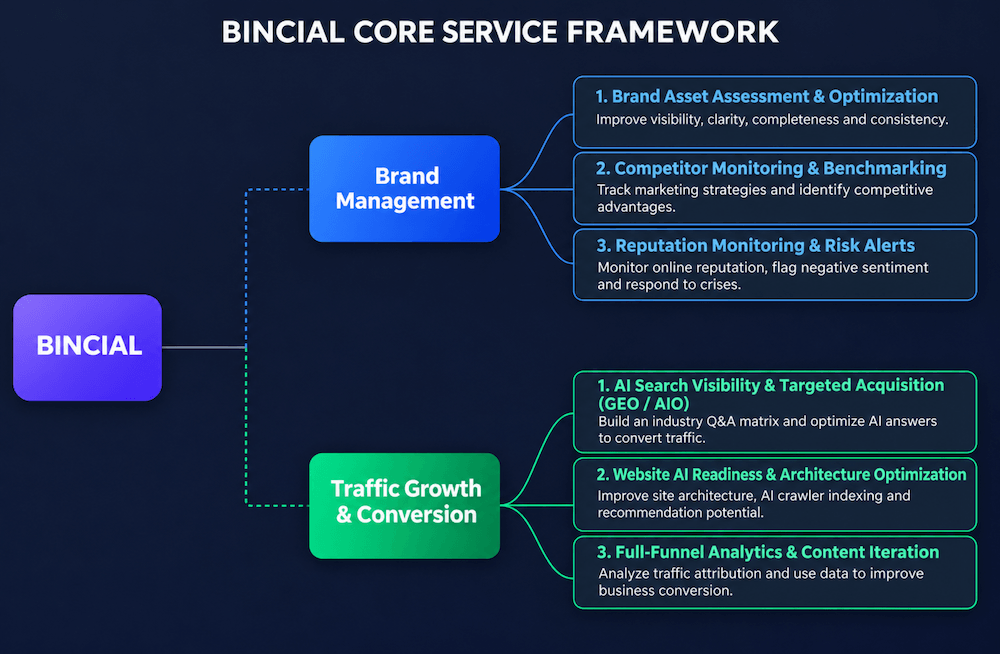
The company specializes in large-model source inclusion, structured content engineering, and digital website development. It has built an end-to-end GEO service platform spanning knowledge bases, content distribution, and performance monitoring, supported by a standardized delivery process. Its Bincial GEO brand serves domestic and international markets, supports more than 20 major AI models worldwide, and provides small and medium-sized businesses with integrated GEO solutions covering AI-ready websites, omnichannel promotion, and performance monitoring.
Objectives and Key Outcomes
This white paper explains how companies can help AI-generated answers cite their verified information accurately. It sets out the operating logic and implementation path of GEO. As AI search restructures traffic flows, the paper provides an end-to-end guide from understanding to execution. Its key outcomes span three levels: first, a foundational framework explaining how brand visibility forms in generative search and where its uncontrollable boundaries lie; second, an engineering approach for turning fragmented information into structured knowledge assets that AI can identify and cite, supported by sustainable operating processes; and third, measurable acceptance standards and an evaluation system, illustrated with practical B2B manufacturing cases that companies can adapt to their own GEO programs.
Key Outcome | What It Covers |
|---|---|
Methodological framework | Build a GEO framework, clarify how brand visibility forms in generative search, and define what a company can optimize and what remains outside its control. |
Knowledge and content engineering | Define a content-engineering approach based on enterprise knowledge and evidence links. Turn fragmented brand information into structured knowledge assets that AI can identify and cite. |
Operational implementation | Explain technical adaptation, publishing review, and automated monitoring. Provide practical guidance for building sustainable GEO operations. |
Performance evaluation | Define verifiable metrics, retesting methods, and acceptance standards to support quantitative evaluation and iteration. |
Case studies | Use anonymized B2B manufacturing cases to demonstrate implementation and provide reusable reference patterns. |
Intended Readers and Scope
This white paper follows six professional themes: system architecture and core concepts; knowledge foundations and content engineering; technical adaptation and source operations; data monitoring and performance evaluation; long-term strategy and risk mitigation; and industry practice and service solutions. Together they describe the full GEO lifecycle from underlying logic to commercial delivery.
It is intended for brand and marketing leaders, website and digital-transformation owners, industry partners, product managers, and practitioners working in search optimization and digital marketing.
The paper focuses on general methodologies and system architecture. It does not disclose the internal algorithms of any platform, guarantee inclusion, citation, or recommendation by any platform, or replace project-specific contractual arrangements. Logic diagrams, field recommendations, and architecture illustrations are explanatory only and do not represent the database schemas or API response formats used in actual delivery.
01 Research Background and System Architecture
Research Background and System Architecture
1.1 Executive Summary
Generative AI has evolved from a tool into a primary information gateway. By the first half of 2026, China had more than 700 million generative-AI users and an adoption rate above 50%. A substantial share of these users treat AI conversations as their first source of information for consumer and procurement decisions [Generative AI Application Development Report (2026)]. Whether AI can read and cite a company’s brand information, product specifications, and service capabilities accurately and consistently now directly determines its visibility to customers.
Business Challenge | Typical Symptom | Direct Impact |
|---|---|---|
Missing online information | The company lacks basic public information online. | AI has little retrievable information about the company. |
Fragmented source material | Facts are scattered across product manuals, websites, presentations, and case studies. | AI cannot reliably understand or cite company facts. |
Blocked page access | Public pages are restricted or technically difficult to parse. | Public content cannot be accessed or read reliably. |
Insufficient expert content | Content is not organized around operating conditions, parameters, and selection criteria. | Answers remain generic and cannot support procurement decisions. |
Weak performance verification | No controlled retesting or lead-source records are retained. | Changes in brand performance and lead contribution cannot be verified. |
GEO, or Generative Engine Optimization, focuses on how brand content is presented and cited in AI search and Q&A. To address the five challenges above, Bincial GEO organizes public-information development, enterprise-knowledge organization, expert content optimization, and continuous performance evaluation into a sustainable product and service workflow that helps companies build and maintain brand-information assets.
Three Operating Principles for Enterprise GEO
Principle 1: Build content on enterprise knowledge
Core idea: make tacit knowledge explicit and structured, creating an authoritative corpus that AI can use.
GEO is fundamentally a competition in source reliability and knowledge density, not exposure alone. When generative engines compose answers, they tend to retrieve and cite content that is factually accurate, logically consistent, and supported by authoritative sources. GEO therefore begins with the company’s own operating context and a rigorous inventory of enterprise knowledge, including product specifications, service processes, answers to industry pain points, and technical white papers.
Operational requirement: convert unstructured business experience into structured knowledge graphs or high-quality corpora. A company should establish clear knowledge entities and relationships around its core business across its official website and authoritative source network so that AI can identify and extract them accurately. Research including GEO: Generative Engine Optimization (Aggarwal et al., 2023) shows that citing sources and adding expert terminology and statistics can significantly improve visibility in generative engines. Content produced without a foundation in real enterprise knowledge is likely to be treated as low-quality noise and excluded from retrieval and citation pools.
Principle 2: Use process control to sustain operations
Core idea: establish a standardized production–distribution–monitoring–feedback workflow that can keep pace with model updates.
Generative-AI models evolve rapidly. Their retrieval logic, source preferences, and interpretation of user intent may change at any time [Gartner Hype Cycle for Artificial Intelligence, 2024, together with industry observations]. Engines also assign very different weights to cited sources, so a one-time GEO intervention cannot deliver permanent results. Companies need long-term operating mechanisms built on process control.
Operational requirement: establish a standardized end-to-end SOP covering knowledge ingestion, content generation, multi-platform distribution, citation monitoring, and strategy refinement.
Two variables require particular attention in day-to-day operations:
- Source lifecycle management: when externally cited data changes or disappears, core properties such as the official website must quickly provide an updated factual baseline.
- Model-trigger adaptation: recalibrate prompt strategies on a schedule that reflects the update frequency of different models. Only by shifting GEO from a one-off project to an ongoing operation can a brand maintain stable visibility in a changing AI ecosystem.
Principle 3: Explain performance through controlled retesting
Core idea: establish a multidimensional evaluation baseline and use reproducible methods to validate GEO returns.
In GEO, the user’s information journey often ends with a direct AI answer. Measurement must therefore move beyond a traffic-only mindset toward cognition and citation. To avoid ambiguous attribution, companies need explicit, objective retesting conditions that use scientific evidence to show how brand influence changes in AI search.
A fixed retesting mechanism should include:
- Set a baseline: record how often the brand appears for a defined set of core questions before intervention.
- Fix the test set: maintain a standardized prompt library covering core business questions, industry comparisons, and long-tail scenarios.
- Quantify core metrics: track mention rate—the frequency with which a brand appears in answers—and citation rate—the frequency with which brand content is cited as a source.
- Control variables: compare results over consistent time windows and platform scopes, separating natural traffic variation and model upgrades from the effect being studied. Controlled retesting validates content strategy and supports long-term decisions about content assets.
Deliverable | What to Verify |
|---|---|
Knowledge assets | What evidence supports each fact—an authoritative source or cross-validation—and which version is current, including structured markup and data definitions. |
Operating process | Who approved the content, where it was published, and how it will be monitored. |
Performance evidence | The denominator for each metric, the location of complete answers and supporting screenshots or logs, and the method for repeating the test. |
1.2 How GEO, SEO, and AEO Differ and Work Together
Companies planning brand visibility in the AI era commonly encounter three concepts:
SEO — Search Engine Optimization;
AEO — Answer Engine Optimization;
GEO — Generative Engine Optimization.
Each addresses a different part of the information journey and requires a different method of organizing content.
First: SEO and GEO divide responsibilities; one does not replace the other
A crawlable website, parseable pages, and consistent facts across channels are both prerequisites for GEO and routine SEO responsibilities. GEO does not invalidate SEO. They address different stages of the same information chain.
Second: the smallest unit of optimization has changed
Traditional SEO treats the page as its smallest unit: keyword placement, title tags, internal links, and page authority are measured and optimized at page level. Generative engines change that baseline. Large models retrieve and cite semantic chunks rather than entire pages. Whether AI can cite content depends on whether the smallest relevant passage can stand on its own, not on page-wide keyword density or backlink distribution.
A page may therefore meet SEO quality standards but still fail in GEO because it lacks independently meaningful passages. Content should be decomposed into evidence cards, each addressing one topic and answering a question without relying on surrounding context.
Third: controllability decreases from SEO to GEO
SEO is relatively controllable: crawler rules and ranking signals can be audited, and causal chains are comparatively clear.
AEO is partly controllable: a company controls content format but cannot control whether an AI summary is triggered.
GEO is a black box: model logic is not visible, the same content may be cited differently by different models or at different times, and models rely heavily on external sources that companies cannot control.
Dimension | SEO | AEO | GEO |
|---|---|---|---|
Target surface | Ranked positions on traditional search-results pages | Existing answer positions such as featured snippets and voice-assistant answers | Recognition, citation, recommendation candidacy, and trustworthy description in AI answers |
Optimization object | Keywords, pages, links, and site structure | FAQs, summary passages, and Q&A content | Enterprise entities, knowledge bases, industry semantics, trustworthy sources, structured information, and multi-platform adaptation |
Common methods | Indexing, relevance, page structure, and user experience | Structured Q&A, FAQ markup, and semantic matching | Knowledge foundations, factual consistency, and citable sources |
Observed metrics | Rankings and clicks | Answer-position coverage | Brand mentions, recommendations, factual accuracy, source citations, competitor presence, and qualified inquiries |
1.3 Industry-Specific Intent and Evidence Requirements
There is no universal GEO content strategy. User intent and decision paths differ significantly by industry, which determines the evidence AI must retrieve to support an answer. Companies should define their priorities according to industry characteristics.
B2B and manufacturing
Decision depth and specifications matter most. Users focus on technical comparisons, compliance standards, supply-chain stability, and implementation cases. AI needs structured specification tables, standards certifications, technical white papers, and detailed reference cases that demonstrate expertise and delivery capability.
Healthcare and finance
Compliance and authority dominate. Users focus on professional diagnosis, risk assessment, policy interpretation, and credential verification. AI looks for authoritative endorsements, professional credentials, expert-authored content, and appropriate disclaimers. Vague statements without official support are likely to be filtered or downweighted.
Consumer goods and retail
Experience and reputation dominate. Users seek recommendations, reviews, value comparisons, and authentic feedback. AI relies on genuine cross-platform UGC, creator reviews, ingredient or material explanations, and after-sales terms, often favoring community content with meaningful interaction.
Local services
Timeliness and location matter most. Users seek nearby recommendations, current opening status, service prices, and real experiences. AI needs current map and POI data, review signals from local-service platforms, specific service details, and working booking paths.
Industry | Decision Cycle and Roles | High-Frequency Intent | Example Questions | Required Evidence | Common Gap |
|---|---|---|---|---|---|
Manufacturing | Weeks to months; procurement, technical, and management stakeholders enter at different stages. | Capability limits, processes, capacity, certifications, MOQ, delivery, samples, after-sales support, and site visits | Which manufacturers can perform process X? How long is delivery for equipment X? How can a buyer assess a supplier’s technical capability? | Verifiable specifications and operating limits, process lists, certification numbers and issuers, capacity and lead-time definitions, test reports, anonymized case data, and a bookable site-visit process | Marketing copy without specification sheets, process cards, or test reports; customization claims without defined limits |
Technology and software | Days to weeks; strong trial intent, usually led by technical roles | Feature boundaries, specifications, integration, compatibility, deployment, security, compliance, pricing, and trial requirements | How does tool X differ from Y? Which APIs does system X support? Can it be deployed privately? How is it priced? | Version comparisons, explicit technical metrics with versions and test conditions, integration lists, deployment options, security credentials, pricing components, and public documentation | Technical claims use adjectives without versions; feature limits and pricing are hidden, forcing AI to infer |
Consumer products | Minutes to days; mostly individual decisions | Reviews, rankings, value, suitable audiences and scenarios, real-world experience, and after-sales policy | Which brand is best? Is X worth buying? Which is better, X or Y? Who is X suitable for? | Third-party reviews and authentic UGC, ingredient or material information, suitable and unsuitable scenarios, price ranges, and return policies | Only first-party product pages are available; AI cannot explain who the product is or is not suitable for |
Healthcare | High professional threshold and strict trust requirements; patients and families decide together under regulation | Credentials, scope of practice, indications, contraindications, source guidelines, clinician background, risk warnings, process, and cost | What tests are usually needed for symptom X? How do two treatments differ? Which department treats X? What are the risks? | Professional credentials, traceable guidelines or literature, named clinician backgrounds, complete risks and contraindications, reviewer and review date, and compliant educational content | Unsigned expert content without sources or review dates; absolute efficacy claims that breach healthcare advertising rules |
Construction and renovation | Weeks to months; owners repeatedly compare providers and emphasize cases and site capability | Qualification level, completed projects, construction process, schedule, quotation basis, local delivery, and acceptance standards | What qualifications does project X require? What is the typical price per square meter? How should a local contractor be selected? | Certificate numbers and levels, verifiable project cases, process standards, schedule and price composition, local service coverage, and acceptance criteria | Case images lack project facts; local terms are missing; quotation logic is opaque |
Logistics and supply chain | Short to medium; primarily business buyers with a strong focus on timeliness | Routes, transit times, pricing components, customs, compliance, exception handling, compensation, and peak capacity | How many days does shipping from X to Y take? How is route X priced? Which customs documents are required? | Route and transit-time tables, pricing and surcharges, service boundaries, customs documents, exception and compensation terms, and peak-capacity guidance | Opaque price components and service boundaries prevent AI from answering cost and timing questions reliably |
Professional services | Medium to long; trust and professional authority dominate | Capability limits, qualifications, methodology, case outcomes, service process, deliverables, and fee logic | How is dispute type X usually handled? Where should an X-industry project begin? How are consulting fees calculated? | Credentials and team background, explicit capability limits, reusable methodology, anonymized cases and outcome definitions, process, and deliverables | Team experience cannot be verified; service names are listed without citable methodology |
Education and training | Medium; learners and parents decide together, emphasizing outcomes and certificate validity | Curriculum, instructors, audience, schedule, location, certificate issuer and validity, duration, and cost | Which X course is credible? Is certificate X useful? How long does learning X take? What background is required? | Complete syllabus, named instructor experience, schedule and location, certificate name and issuer, entry requirements, and verifiable learner outcomes with denominators | Outcome claims omit denominators; instructors are unnamed; certificate validity is unclear |
1.4 Bincial GEO Functional Logic and System Architecture
The system takes enterprise materials and categorized questions as inputs and connects knowledge management, content operations, and monitoring records. Updates to the enterprise knowledge base affect subsequent content tasks; changes in published answers and citations then become inputs for diagnosis and iteration, creating a data flywheel.
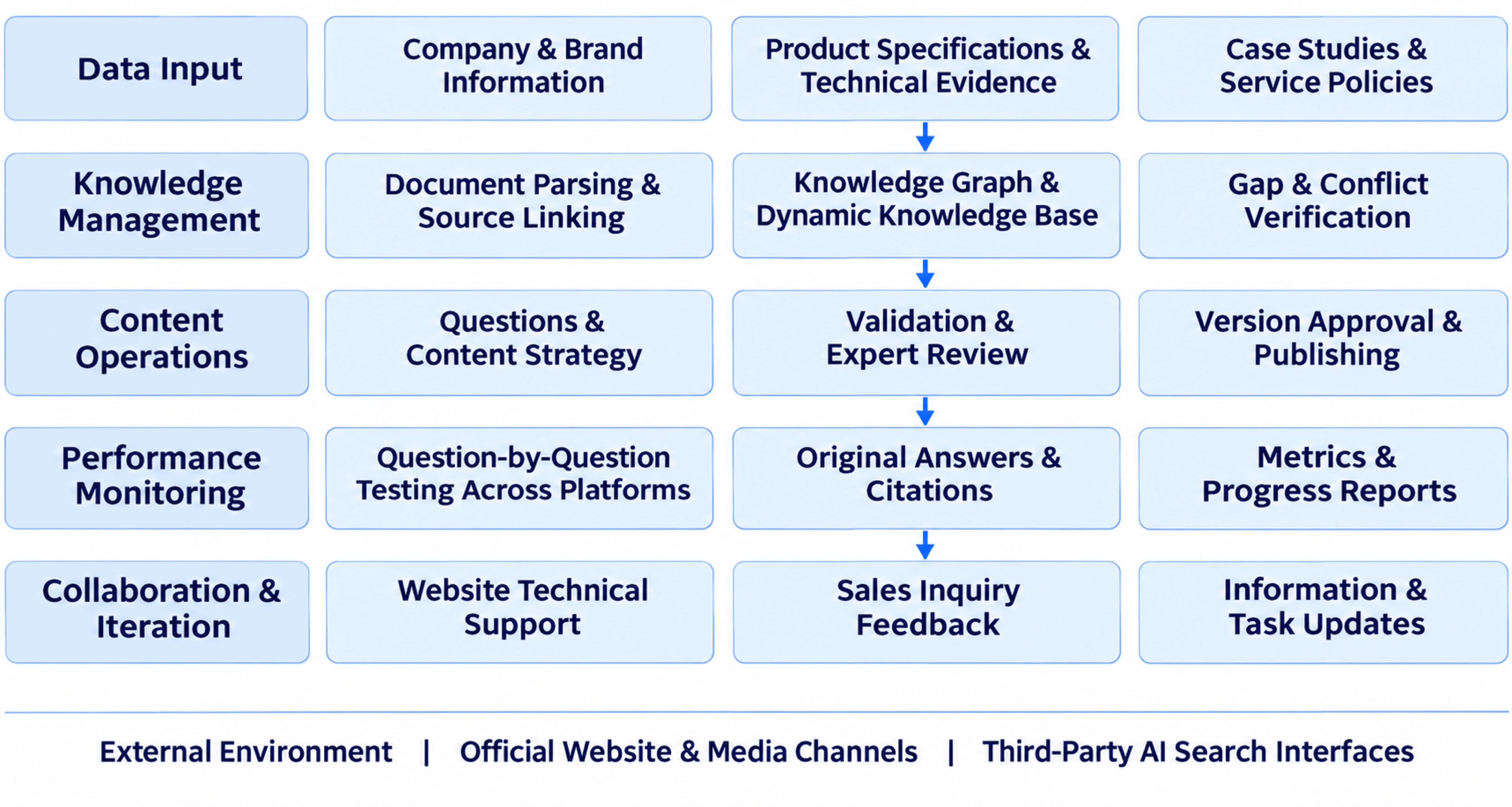
Note:The solid outline marks the scope deliverable by Bincial GEO; text below it represents the external environment.
Arrows indicate workflow relationships only and do not imply training or modifying the parameters of third-party models.
02 Enterprise Knowledge Foundations and Content Engineering
Enterprise Knowledge Foundations and Content Engineering
2.1 Question-Set Design and Baseline Diagnosis
The question set is the starting point for GEO development and the common yardstick for evaluating subsequent results.
First define target customers, decision-making roles, product scope, and target markets. Then turn sales inquiries, presales conversations, and customer feedback into natural-language questions. The set should cover need recognition, solution exploration, supplier screening, purchase validation, and post-purchase service. Avoid testing only the full brand name or signaling a preferred recommendation in the question itself [LUT Repository: detailed discussion of the Webster and Wind model].
Decision Intent | Diagnostic Focus | Example Questions and Content Directions |
|---|---|---|
Need recognition | Does the answer explain the real pain point? | Question: What are the main pain points or compliance risks currently facing industry X? |
Solution exploration | Does it explain the basis for selection? | Questions: How should technology path X be evaluated? What are the advantages and disadvantages of building in-house versus buying SaaS? |
Supplier screening | Does the brand enter the relevant candidate set? | Questions: Which domestic or international vendors lead category X? What is brand X's reputation in the industry? |
Purchase validation | Are brand facts and evidence complete? | Question: What are brand X's technical specifications, implementation timeline, and successful cases? |
Use and service | Does it provide actionable guidance? | Questions: How should equipment X be maintained? How is an API configured after software deployment? |
Organize Core and Exploration Sets by Decision Intent
When building a question set, companies should avoid the self-reinforcing blind spot of testing only the complete brand name. Questions should follow the target customer's decision funnel and be divided into a core set and an exploration set:
- Core set (high-conversion intent): brand terms, competitor-comparison terms, and core product or service terms used to test the brand's presence and defensive strength within the existing awareness pool.
- Exploration set (broad intent): industry pain points, long-tail scenarios, and explanations of technical principles used to test expertise and acquisition strength while demand is still emerging.
Questions must remain objective and neutral. Prompts must not presuppose a recommendation—for example, “Why is X recommended?”—because anchoring and sycophancy can distort a model's output.
Turn Baseline Gaps into a Development Backlog
Before formal GEO optimization begins, run an uncontrolled baseline blind test.
Without any prior content distribution or structural optimization, ask a standardized prompt library across multiple AI engines and retain complete screenshots and citation links. The purpose is to identify gaps between AI's current understanding and the company's intended representation, then turn those gaps into a concrete development backlog:
- Fact gap: if parameters or credentials in an AI answer conflict with official information, add brand-fact baseline calibration and structured Schema markup to the backlog.
- Evidence gap: if AI does not mention the brand—or mentions it without a citation—in answers to questions such as “Which provider is best for X?”, add authoritative third-party review sources and distribution through vertical industry media.
- Structure gap: if AI quotes content out of context or misses the core value proposition, add an FAQ restructuring task. Baseline diagnosis becomes a useful construction blueprint only when identified gaps map directly to engineering tasks for content assets.
Establish Dynamic Retesting and Question-Set Iteration
GEO is a dynamic competitive process: model logic and source ecosystems continue to evolve. A question set therefore cannot remain static and needs a recurring retest and iteration mechanism.
- Control retest variables: keep the platform scope, time of questioning, question length, and other variables relatively stable so baseline data remains comparable and changes can be attributed to recent optimization work.
- Expand the question set dynamically: as product lines change, new regulations take effect, or competitors introduce new strategies, add emerging scenario terms and long-tail questions to the exploration set on a monthly or quarterly basis.
- Connect dashboards and alerts: feed the question set into an ongoing AI-visibility dashboard that tracks mention rate, first-recommendation rate, and citation rate. A sharp decline in the first-recommendation rate for core questions, or a negative brand summary in exploration questions, should immediately trigger an operational alert and a new cycle of reputation response and content refresh.
Bincial GEO Console Example
Once standards for the core and exploration sets are defined, companies must turn abstract questions into measurable indicators that can be tracked continuously. Without monitoring tools, a question set often becomes a one-time diagnostic report rather than a dashboard for long-term operations.
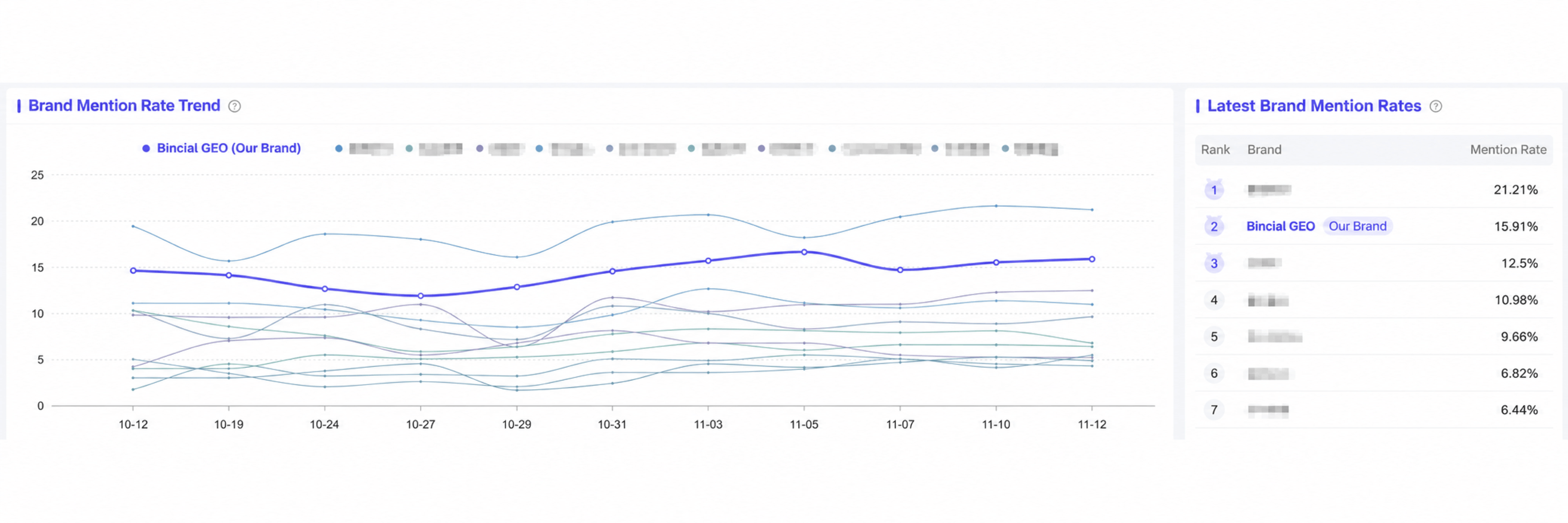
The Bincial GEO console connects the standardized question library to an ongoing monitoring engine.
As shown below, the system automatically tracks and records trends in the brand's category mention rate across major AI engines. This makes changes in the brand's level of recognition within the AI answer ecosystem visible. The latest category mention rate also provides direct evidence of whether a content-distribution or strategy adjustment was effective, supporting objective iteration of the development backlog.
2.2 Enterprise Material Processing and Knowledge Ingestion
Ingesting enterprise materials is not a one-step “upload and vectorize” operation. It is a multi-stage pipeline that includes parsing, cleaning, chunking, labeling, and storage. The engineering decision with the most direct impact on GEO performance is the chunking strategy: it determines the granularity at which knowledge enters the vector index and sets the practical ceiling for retrieval quality.
Chunk size creates a measurable precision–recall tradeoff.
A 2026 comparative study published in ACM's Cybernetics and Systems Analysis evaluated fixed windows of 256, 512, and 1,024 tokens against semantic chunking on the SQuALITY dataset. Smaller fragments delivered higher retrieval precision (Precision@5), while larger fragments significantly improved recall (Recall@5) and answer F1 quality [ACM, Cybernetics and Systems Analysis]. Another systematic analysis of industrial question-answering systems found sentence-level chunks to offer the best cost-performance balance, but answer quality declined after context exceeded roughly 2,500 tokens—a “context cliff.” Chunking is therefore not a one-way choice between “smaller is more precise” and “larger is more complete.” The working range must reflect the semantic density of the company's knowledge.
Bincial GEO's knowledge-base design follows this principle. Enterprise materials are not ingested as whole source files. They are decomposed into semantic units capable of answering one question independently, then vectorized. Basic brand information serves as a shared layer, while each product line separately organizes foundational information, core products and services, company value and background, honors and credentials, and product-line details. Corporate image assets and uploaded-file records are managed alongside them.
Source materials, knowledge content, and external publications serve different purposes: source materials preserve evidence, the knowledge layer unifies facts, and publications turn those facts into professional answers to customer questions.
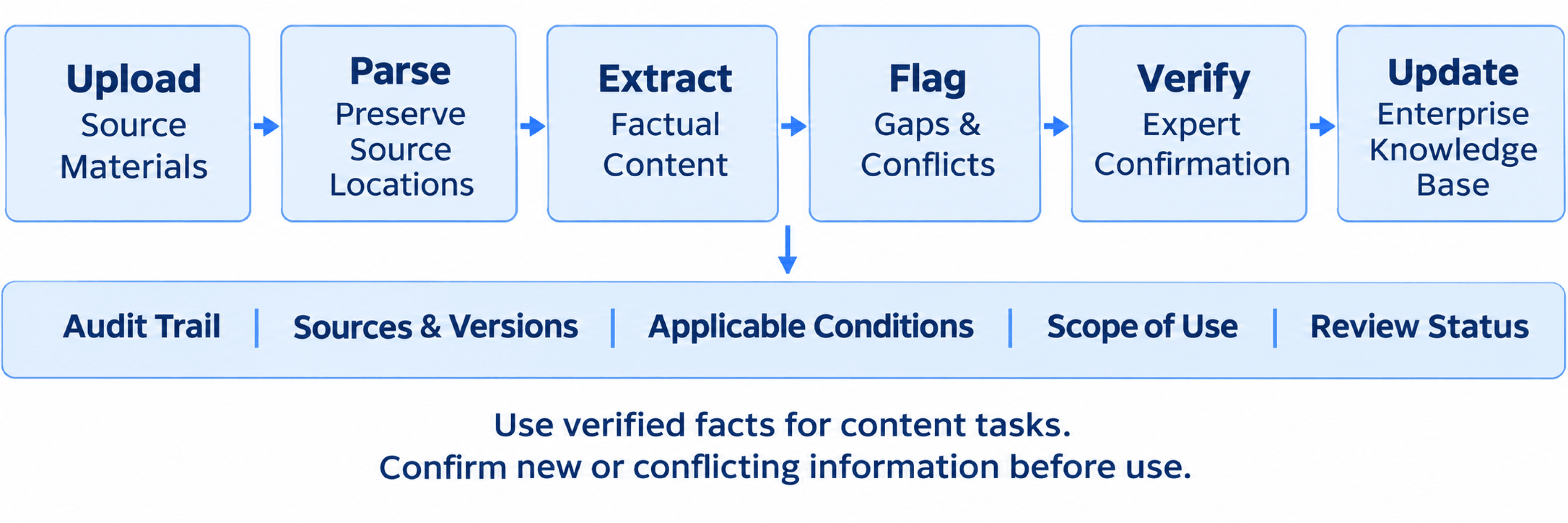
Note: after source files are archived, they are parsed, facts are extracted, and professional verification is completed before usable knowledge is created. Every retrieval retains the material version and source location.
2.3 Brand Knowledge Graphs and Evidence Links
The Bincial GEO knowledge base uses a structure of shared brand facts plus independent materials for multiple product lines.
Basic information establishes a consistent company and brand identity. Each product line separately explains its business, cases, differentiators, and credentials.
The knowledge graph then expresses relationships among entities, products, applications, and evidence, allowing later content tasks to select relevant facts instead of repeatedly applying the same company profile.
Knowledge Object | Primary Information | Association Rules |
|---|---|---|
Basic brand information | Company and brand names, background, credentials, contact details, and official website | Shared facts across product lines, keeping the entity and wording consistent |
Product-line materials | Detailed descriptions, customer cases, differentiated capabilities, and business credentials | Maintained separately by product line and linked to applicable scenarios and conditions |
Applications and cases | Problem addressed, service process, results, and statistical scope | Linked to the specific business and evidence, without extrapolating a general promise |
Images and source files | Image assets, originals, and upload records | Used to verify source, version, purpose, and permitted disclosure scope |
Content-use relationships | Knowledge entries, topic pages, and external publications | Checked for consistency against the materials used, with update verification scheduled |
Unify Entity Identifiers
Brand aliases, English names, corporate entities, and official website addresses should remain consistent.
Multiple product lines may share brand facts, but their parameters, intended users, cases, and credentials must be managed separately so that one product line's capability is not extended to every business. Each use of a source should verify the entity, version, conditions, and disclosure scope. Original-file directories and upload records support source verification.
2.4 Dynamic Knowledge-Base Updates and Refresh
Knowledge ingestion is not a one-time project. RAG systems face a structural risk of index decay: a document may be updated while its vector index retains the old version, or a document may be deleted while obsolete chunks remain retrievable. GEO amplifies this risk because outdated information cited by AI can appear directly as a brand statement in a generated answer, often before the company notices.
The engineering objective of dynamic updates can be divided into four constraints: timeliness, accuracy, consistency, and rollback capability [RAG knowledge-base update practices: incremental synchronization, version control, deduplication, and full rebuilds].
Bincial GEO's knowledge-base design addresses these constraints through the following approach:
Event-Driven Incremental Processing Instead of Full Rebuilds
Three document events—creation, modification, and deletion—trigger different index operations.
New documents enter the ingestion pipeline; modified documents re-embed only the changed portions; deleted documents remove their corresponding chunks. A full rebuild is reserved for structural changes such as switching embedding models, controlling cost and latency.
Refresh Rather than Simple Overwrite
Old knowledge is not silently replaced. It enters a version-retention and status-marking mechanism. If reinspection finds that a statement associated with a saved proof image or verified claim has changed or been removed, the existing verification status expires and the item returns to the pending queue.
This design addresses soft deletion and index consistency in RAG updates: obsolete content should not remain retrievable simply because it still exists physically in the index.
Link Knowledge Updates to Scenario-Question Checks
After knowledge is saved and verified, the system rechecks affected scenario questions. If updated materials change brand facts required for a category of questions, the generation restrictions for those questions are refreshed at the same time. A knowledge-base update is therefore not an isolated maintenance action but a trigger in the closed loop of GEO operations.
2.5 Professional Content Generation and Quality Control
Ensure Content Is Publishable in Fact and Compliance Terms
The central risk in content generation is not whether the writing sounds good, but whether its claims are trustworthy.
Independent studies repeatedly measure fabricated citations and factual errors in generative AI. In one review of medical literature, 34% of references from the worst-performing model were fabricated or unverifiable. A large study of news responses from AI assistants found that 45% contained at least one significant issue and 31% had serious source-attribution defects [Medical references generated by AI platforms]. Publishing unconstrained AI-generated content in a GEO workflow therefore hands the brand's authority to make claims to a system with a measurable tendency to hallucinate.
Quality control in the Bincial GEO knowledge base is not an after-the-fact review. Constraints are moved before and into generation, creating three gates:
Gate | Trigger | Control | Engineering Implementation |
|---|---|---|---|
Ingestion gate | When materials enter the knowledge base | Completeness validation and identification of missing proof | Material-completeness score; unverified claims are excluded from generation |
Generation gate | Before content is prepared for external output | Information-quality score; generation requires at least 70 points | Six deduction categories, including numerical-definition consistency, advertising-law compliance, and temporal consistency |
Publication gate | When generated results are submitted | Automatic AI correction, human confirmation, and verification lock | Mechanical errors such as typos and mixed abbreviations are corrected automatically; semantic and compliance issues enter a revision queue |
The separation between automatic correction and compliance blocking deserves emphasis. Bincial GEO treats mixed use of full and abbreviated brand names, typographical errors, and malformed sentences as mechanical issues. AI corrects them during the first validation pass without user action, while each correction remains reversible as protection against false positives. Superlatives and absolute claims, by contrast, require semantic judgment rather than simple text matching.
This separation reflects a central quality-control principle: automatable conformity issues and substantive issues requiring judgment should not share one pipeline. Otherwise, false positives overwhelm reviewers or truly high-risk statements disappear into noise.
Organize Articles Around Scenario Questions
Each content task first defines its audience, the problem it addresses, the relevant product line, and the facts and cases it may use. The opening gives a direct answer, followed by the rationale, applicable conditions, operational steps, or comparison dimensions. Tables support decisions where useful; real cases add application evidence; and the ending points readers toward relevant products, cases, or consultation paths. Different questions receive separate content. When facts are insufficient, verify them first instead of repeatedly republishing one article with changed keywords.
Quality Dimension | Prepublication Check |
|---|---|
Intent and value | Does it answer the target question and provide new experience or a basis for judgment? |
Facts and evidence | Can every name, number, unit, and condition be traced to valid materials? |
Structure and completeness | Are conclusions, comparisons, steps, and limitations clear, and are charts readable? |
Consistency and authorization | Are the brand, version, market definitions, and asset-use permissions consistent? |
Manage Generation and Review Separately
Asking a large model to “write an article about us” and publishing it directly is one of the most dangerous GEO practices.
Bincial GEO separates content production into two independent engineering stages:
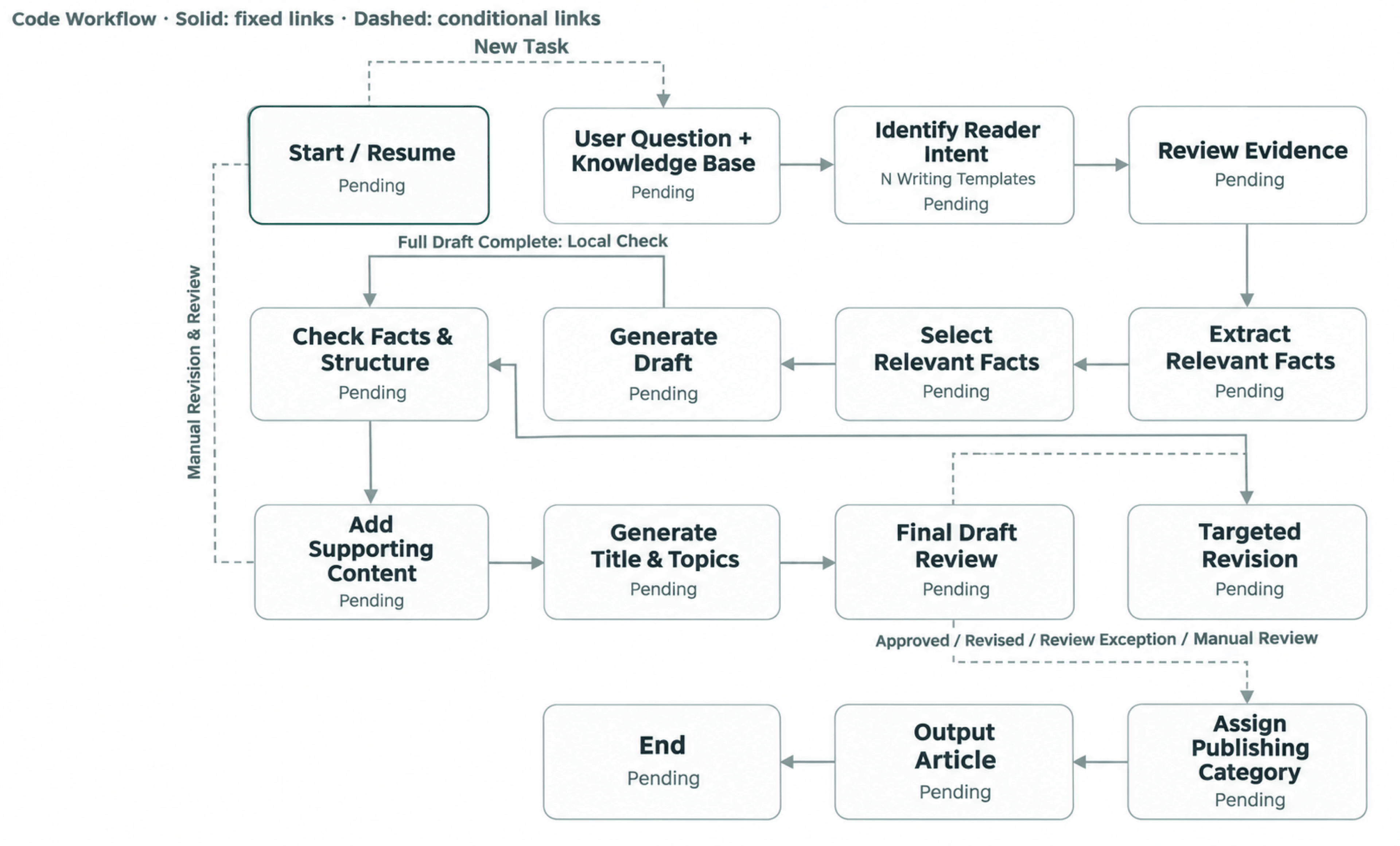
- Generation stage (AI): creates a draft for a scenario question using cleaned and linked brand knowledge assets. Output is subject to two hard prerequisites: a verified fact exists in the knowledge graph, and the information-quality score is at least 70.
- Review stage (system and human): the draft is not published directly. It enters a quality-validation queue that checks not only compliance—including advertising rules and factual consistency—but also evidence alignment. Every cited brand data point must match a source file in the knowledge base. Claims without proof, such as an award whose certificate was not uploaded, are forcibly removed and excluded from external generation.
The following diagram shows how the complete large-model article-generation workflow is connected inside Bincial GEO:
Content Matrix and Article-Organization Method
A content matrix connects the decisions customers must make with article types, knowledge materials, and publication plans.
One product line can cover business understanding, solution comparison, capability validation, and purchase discussions at the same time. Build order should reflect baseline gaps, available evidence, and business priorities rather than a fixed article count or ratio for every industry. Because a single article has limited coverage, companies need a content matrix spanning the customer's entire decision cycle.
Customer Task | Content Focus | Required Knowledge and Evidence |
|---|---|---|
Understand the business and problem | Explain concepts, causes, applicable scenarios, and the solution's scope | Brand positioning, product introductions, industry terminology, and application conditions |
Compare feasible solutions | Explain selection criteria by operating conditions, performance, implementation requirements, and cost of use | Product-line parameters, solution descriptions, and applicability limits |
Validate supplier capability | Answer questions about service scope, technical capability, and similar project experience | Credentials, genuine cases, delivery, and service descriptions |
Confirm purchase and delivery | Explain consultation preparation, implementation steps, acceptance, and after-sales conditions | Process documents, delivery checklists, and current policies |
Support use and ongoing cooperation | Address common usage questions and explain maintenance and service access | Instructions, FAQs, and verified customer feedback |
Within one intent dimension, questions should not be highly repetitive, and each article should exist as an independent evidence card in the source matrix. Across dimensions, factual definitions must remain consistent—for example, the number of pricing plans must be identical in every article in the matrix.
2.6 Five Modules Share One Engineering Backbone
Scenario-question design and baseline diagnosis determine what AI should answer and how it answers today.
Material ingestion determines whether AI can find and understand the information.
Knowledge graphs and evidence links determine whether AI is discussing the same entity and whether each claim is supported.
Dynamic updates determine whether cited information remains current.
Content generation and quality control determine whether AI output is publishable.
Together, the five modules form a complete processing chain from demand definition to finished delivery. The output of each stage becomes the input of the next. If any stage is missing, downstream work loses validity and GEO knowledge assets degrade into an unaudited accumulation of text.
03 Website Development and Technical Readiness for AI
Website Development and Technical Readiness for AI
3.1 Capturing Demand: The Official Website's Core GEO Value and Positioning
A Fundamental Change in the Website's Role
In traditional SEO, the website value chain was: ranking → click → visit → conversion.
In GEO, that chain is compressed: AI citation → brand awareness → branded search → website visit → conversion.
Traditional Positioning | GEO Positioning | Core Difference |
|---|---|---|
Digital corporate brochure | AI-retrievable knowledge node | The website must be readable not only by people but also by models [Structured website transformation] |
Landing page for search traffic | Traceable anchor for AI answers | Being cited has value in itself; clicks are no longer the only metric |
Repository for marketing collateral | Supply point for structured facts | Every specification, case, and credential is an extractable fact unit |
The Official Website Is the Only Fully Controllable GEO Source
Within the source ecosystem of AI search, third-party content is constrained by platform recommendation algorithms, so companies cannot fully control its exposure or presentation. Only the official website—from its structure and content to Schema markup and conversion paths—is entirely controlled by the company [Citation-source testing and content distribution]. Bincial therefore positions the website as the “source anchor” in its GEO service. Core facts in all externally distributed content—company details, product specifications, certifications, and contact information—must match the website. When AI cross-validates multiple sources, the official website serves as the authoritative baseline.
3.2 Machine Readability: Optimizing Website Architecture for AI
A website must combine search accessibility, clear enterprise facts, and inquiry capture. Access and indexing, page organization, structured information, content, experience, and business entry points should be checked against the table below. Google-specific requirements apply only to the relevant search context, but foundational SEO work also applies to its AI search features; strong and trustworthy content remains the basis for appearing in AI Overviews [AI search].
AI Crawlers and Traditional Crawlers Read Websites Differently
Traditional search crawlers such as Googlebot and Baiduspider aim to discover pages, build an index, and return links.
AI crawlers such as GPTBot, Bytespider, ClaudeBot, and PerplexityBot aim to acquire high-quality content, extract factual passages, and support generated answers. Their technical requirements differ, producing the following implementation and acceptance criteria:
Technical Dimension | Traditional SEO Requirement | Additional GEO Requirement | Bincial Implementation |
|---|---|---|---|
robots.txt | Allow major search-engine crawlers | Allow dedicated AI crawlers such as GPTBot, Bytespider, and ClaudeBot | Before delivery, verify each major AI crawler User-Agent is not blocked accidentally |
Rendering | Support JavaScript rendering | Prefer SSR or SSG because GPTBot and CCBot have limited client-rendering support | Core facts must appear in server-returned HTML |
Sitemap | General sitemap | A dedicated high-quality page list can be provided for AI crawlers, excluding low-value pages | Improve crawl efficiency and focus limited crawl budgets on core pages [AI search content-indexing mechanisms] |
Content format | Text and images | Core facts must be in HTML body content; AI cannot reliably retrieve facts embedded only in images, Canvas, or injected JavaScript | Put product specifications, case data, and credential text in HTML |
Structured Data: Establishing the Brand's Identity in the AI World
For entity recognition, AI must first determine which company a brand refers to. JSON-LD structured data is currently the most efficient entity identity document [Structured data and entity recognition].
Bincial GEO requires at least the following three Schema types on an official website. Marked-up data must exactly match visible page text; inconsistencies may be treated as manipulation and reduce trust:
- Organization: deploy site-wide, prioritizing the home page. Core fields include company name, website URL, logo, links to official accounts, and a concise company description. This resolves entity ambiguity when a brand name overlaps with a common term.
- FAQPage: deploy on FAQ and product Q&A pages. Use authentic customer questions and answers whose first sentence gives the conclusion directly. Q&A is structurally aligned with AI answers and is easy to cite. Each FAQ item should stand alone and answer only one question.
- Service / Product: deploy on service or product detail pages. Core fields include name, description, intended users, and delivery method. When users ask what a service or product is, AI can extract accurate, complete structured information from this markup.
An often-overlooked detail: the sameAs field provides a technical solution for consistency across sources. Linking the official website to verified organization profiles, encyclopedia entries, LinkedIn, and other official destinations in Organization markup helps AI normalize those sources to one entity during cross-validation. Bincial GEO verifies every sameAs link to avoid dead links creating new inconsistencies.
Six Layers of Bincial GEO Website Development and Verification
Layer | Technical and Content Requirements | Verification |
|---|---|---|
Access and indexing | HTTPS and valid status codes; verify that robots, noindex, and WAF rules do not block content and that essential body text is readable | Response, crawl-log, and URL checks |
Page organization | Heading hierarchy, internal links, Sitemap, and canonical tags; maintain URL and language relationships for multilingual pages | Rendered-content, URL, and navigation checks |
Semantics and entities | Choose Organization, Product, Article, Breadcrumb, or other markup to fit the page entity and match visible content | Structured-data and factual-consistency validation |
Professional content | Create pages for brands, product lines, scenarios, cases, and questions; accompany PDFs with HTML body content or summaries and preserve versions and sources | Evidence can be located for representative purchase questions |
Mobile and experience | Mobile adaptation and image alt text; evaluate loading, interaction, and layout stability with LCP, INP, and CLS | Mobile review, experience testing, and event testing |
Inquiry and data | Provide working contact, form, download, and other entry points; record available sources, paths, and key events | Entry-point integration, event records, and business verification |
Companies should note three practical points when using this table:
- Verification matters more than the requirement itself. Many AI-readiness problems persist not because teams do not know what to implement, but because nobody validates the result. A robots.txt file may accidentally block GPTBot, or a WAF may classify an AI crawler as an attack. Only crawl logs and URL checks reveal these failures.
- Professional content distinguishes GEO acceptance from conventional website acceptance. Conventional acceptance asks whether a page exists; GEO acceptance asks whether evidence for a representative purchase question can be located on it. Test with three questions real customers ask. If the answers cannot be found, the layer has not passed.
- The inquiry and data layer determines whether GEO ROI can be measured. Without events, source attribution, and path records on inquiry entry points, leads referred by AI cannot be attributed and GEO performance becomes a matter of intuition. Bincial GEO requires a closed loop of entry-point integration, event recording, and business verification.
3.3 Intent Response: Website Content Matrix and Conversion Design
Technology makes content readable to AI; content makes it worth citing.
The website content plan should be based not on what the company wants to display, but on what users ask at each decision stage.
Two Implementation Rules
- FAQ is the most cost-effective GEO page format. AI receives a question and an FAQ provides an answer, so the structures align naturally. Follow three rules: use authentic customer wording, give the conclusion in the first sentence, and answer only one question per item.
Match the CTA to the intent stage; do not ask awareness-stage users to complete a quotation form.
For awareness and exploration, offer low-friction actions such as downloading a white paper or selection checklist with email only.
For evaluation, offer a medium-friction action such as booking a diagnostic with name and contact details.
For decision, offer high-intent actions such as requesting a quote or demo, keep the form to three fields or fewer, and respond quickly.
3.4 Conversion Improvement: Turning Visits into Commercial Leads
Visitors referred by AI have already completed initial information screening within the conversation and are often in the middle or late stages of a decision. The website need not educate them from the beginning; it must quickly provide validation evidence. Specific numbers outperform adjectives: “serving 300+ companies” is stronger than “highly experienced,” and “92% renewal rate” is stronger than “high customer satisfaction.”
Conversion design should therefore progress through three stages: attention, trust, and action. Above the fold, positioning, core services, and trust metrics answer “Is this relevant to me?” Case pages use quantified results, verifiable credentials, and white-paper downloads to answer “Is this true?” Inquiry points use a free diagnostic, trial, refund commitment, or another low-risk offer to answer “What do I gain by contacting you?” CTA friction should match intent: light actions for awareness and exploration, a booked diagnostic for evaluation, and quote or demo requests for decision-stage visitors, with no more than three fields and a fast response.
04 Source Development, Publishing, and Automation
Source Development, Publishing and Automation
4.1 Source Development and Domestic and International Publishing
Source development maps content tasks to channel roles. The official website carries complete brand, product, case, and service information. Professional media and industry platforms provide public entry points around relevant issues. Cases, technical materials, and Q&A are organized separately according to the evidence customers need to decide.
Bincial GEO plans distribution for domestic and international markets and evaluates coverage using actual publication records and subsequent retesting.
Select and Maintain Channels by Evidence Purpose
Channel selection considers industry relevance, reader needs, body-content accessibility, and long-term maintainability.
Explanatory content helps users understand a problem; selection content provides a basis for comparison; cases and credentials support business validation. Each item links to the corresponding product, evidence, or inquiry path on the official website. The same topic may be adapted in tone and length by channel while retaining facts, parameters, and conditions. Company-authored statements, sponsored pieces, and independent reviews should identify the nature of their source.
Adaptation Area | Domestic Content Task | International Content Task |
|---|---|---|
Customer questions | Industry, actual service region, and purchasing process | Target country, role, and local purchasing terminology |
Evidence materials | Chinese specifications, application cases, and credential scope | Specifications in the relevant language, certification scope, and export conditions |
Content channels | Official website, relevant industry platforms, and professional media | Independent site, local industry resources, and professional materials |
Business capture | Service boundaries, technical consultation, and contact paths | MOQ, samples, lead time, after-sales support, and contact paths |
Verify Publication, Retrieval, and Answer Adoption Separately
After publication, verify the body content, URL, publication time, and approved version, then monitor changes in retrieval and citation for target questions. Record whether a citation comes from the official website, industry media, or another source, and confirm that the source supports the answer's conclusion. When no explicit source is shown, count only brand performance; do not infer that a particular article was used.
4.2 Automated Tasks and Publication Review Controls
Bincial GEO uses scenario questions to connect knowledge preparation, article generation, review and publication, and monitoring feedback. The platform performs automated generation, publishing, and recording, while the project team confirms facts and exercises professional judgment.
The table below defines actions and outputs for each stage as the working basis for continuous operations:
Stage | Action | Content or Record Produced |
|---|---|---|
Question planning | Set priority questions using the baseline, purchase scenarios, reputation signals, and competitor gaps | Scenario questions, keyword themes, and content priorities |
Knowledge preparation | Select shared brand facts and relevant product-line materials; verify source and disclosure scope | Materials used, applicable conditions, and items requiring verification |
Article generation | Organize the title, direct answer, rationale, and application guidance around the scenario | Article draft, evidence citations, and related content entry points |
Review and confirmation | Check facts, professional conclusions, permissions, and channel-specific expression; approve the scheduled draft | Review comments, approved version, and publication scope |
Publication verification | Publish by channel and check page content, status, and time | Article, platform, scenario question, and publication record |
Monitoring and analysis | Observe brand, recommendation, and citation performance using the same question and entry point; interpret it with website behavior | Answers and sources, content gaps, and conversion observations |
Review and update | Verify anomalies, supplement materials, revise pages or topics, and schedule retesting | Revision tasks, updated content, and subsequent verification results |
Bind Review to a Specific Version
Review confirms facts, permissions, final copy, and channel. Reconfirm when the version, destination URL, or material evidence changes. After publication, inspect the actual page and retain its URL and version. If an error is found, pause affected tasks before revising or withdrawing the content.
Make Failures Recoverable and Manual Changes Traceable
Record the task, operator, reason for adjustment, retry count, and final status. Verify the channel and version before retrying to prevent duplicate publication. If a timeout or platform restriction occurs, pause for verification rather than marking the task complete. Create a new version when the question set or test conditions change.
Use Publication Records to Connect Content with Target Questions
AI publication records link each article, platform, keyword, scenario question, publication status, and time. They support filtering and inspection while showing generation and publication progress and review entry points. Check content coverage and execution by question, then compare them with same-question monitoring and website behavior. Publication, indexing, citation, and qualified inquiries must each be verified separately.
05 Data Monitoring, Evaluation, and Project Delivery
Data Monitoring, Evaluation and Project Delivery
5.1 Monitoring Loop: Automated Collection and Record Retention
Bincial GEO monitors platform entry points and question sets, continuously observing brand mentions, recommendation positions, factual descriptions, explicit sources, reputation signals, and competitor performance. Each task retains the question version, execution conditions, raw answer, and status before results are aggregated into monitoring and reports. Countries, languages, entry points, and time windows are reported separately; API results are not mixed with consumer product interfaces.
| Record Group | Key Content |
|---|---|
| Task and question | Task ID, original wording, question version, intent, and batch |
| Execution conditions | Platform and entry point, visible version, region and language, web access, and session state |
| Time and status | Execution time, validity, timeout or restriction reason, and retry relationship |
| Raw evidence | Complete answer, explicit citation URLs, screenshots, and accessible verification entry points |
| Assessment details | Entity match, recommendation context, order, factual errors, and review records |
Distinguish No Brand, No Citation, and Execution Failure
A complete answer that does not mention the brand belongs in the valid-answer denominator and counts as no mention. An answer without an explicit source is recorded as no citation. Refusals, timeouts, CAPTCHAs, access restrictions, and incomplete collection receive separate statuses under predefined validity rules. Unfavorable answers must not be deleted to improve ratios.
Store Raw Records Separately from Analytical Results
After retaining raw answers, separately record brand matching, recommendation context, list order, and fact-verification results. Spot-check same-name false matches, negative recommendations, and citations that do not support the conclusion. Reports must trace aggregate findings back to individual questions.
5.2 Metric Definitions and Calculation Rules
GEO evaluation should answer four questions: which topics were covered, how the brand appeared, whether the information was correct, and whether business feedback resulted. Development outputs, test performance, platform citations, and website business data are reported separately. Every percentage includes its numerator, denominator, scope, and period and is not presented as a universal industry score.
| Metric | Working Definition and Denominator | Counting Rule |
|---|---|---|
| Brand mention rate | Valid answers mentioning the target brand ÷ all valid answers | Multiple mentions in one answer count once |
| Recommendation rate | Answers explicitly recommending the brand ÷ valid recommendation-type answers | Ordinary mentions and negative recommendations do not count |
| First-position recommendation rate | Answers ranking the brand first ÷ valid list-type answers | Only lists with explicit ordering count |
| Factual accuracy | Correct fact items ÷ expressed and reviewed fact items | Unverifiable items are reported separately |
| Required-fact coverage | Correctly expressed required facts ÷ all predefined required facts | Verify each answer before aggregation |
| Specified-source citation rate | Answers explicitly citing a specified source ÷ all valid answers | Define the domain or page scope; citation is not recommendation |
Layered Evaluation Framework
Interpret evidence in three layers: L1 model-layer metrics—mentions, recommendations, first position, factual accuracy, required-fact coverage, and specified-source citations—are direct results assessed as baseline-to-retest differences under the same questions and entry points. L2 website traffic is supporting evidence affected by seasonality and other promotion. L3 qualified inquiries and acquisition cost are business outcomes that show correlation, not standalone attribution. L2 or L3 changes must not be attributed to GEO when L1 is unchanged.
Define the Denominator Before Explaining Change
Each question, entry point, and execution is one planned observation. Complete answers with no brand mention remain in the denominator. Valid-answer rate equals valid answers divided by planned observations; retries do not increase the planned count. Question coverage is calculated on deduplicated questions, and a zero denominator is marked not applicable.
5.3 Performance Retesting: Design and Attribution
Retesting asks whether performance on the same questions changes consistently, not whether a team can select the best screenshot. AI answers are stochastic, while platform versions, login state, memory, language, and web access can all affect results. Preserve execution conditions, multiple observation points, and change records.
Fix the Core Sample and Observe Multiple Points in Time
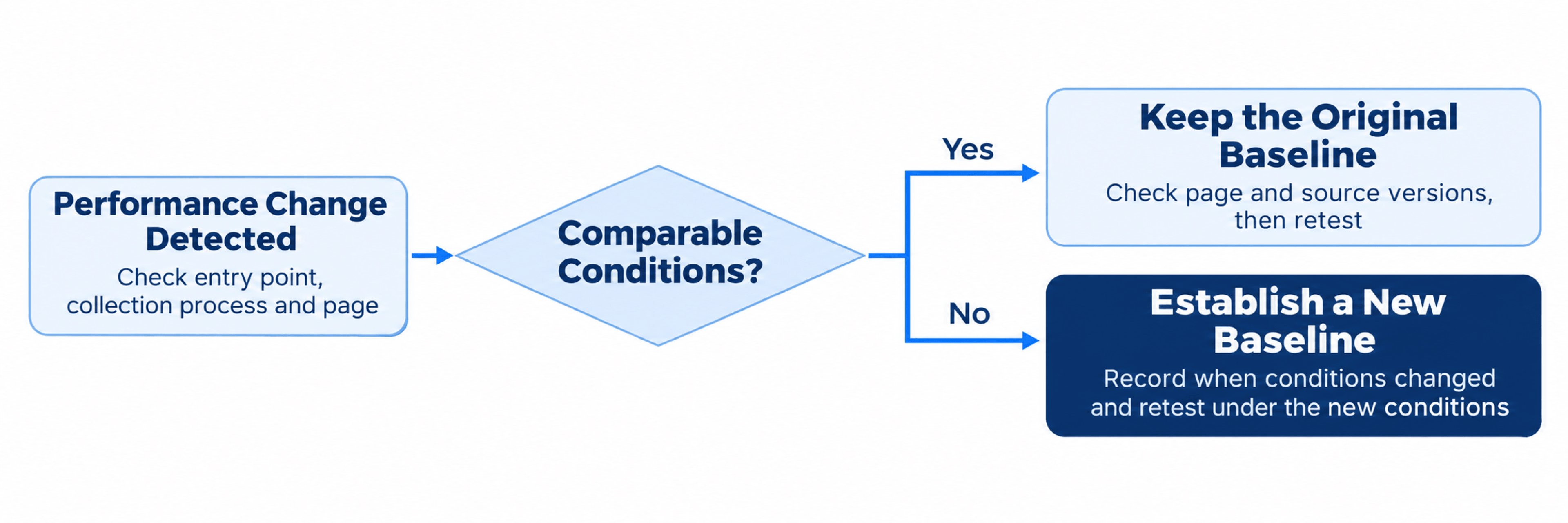
Before the baseline, agree on the question set, entry points, batches, repetition count, statistical window, and judgment rules. Use comparable independent sessions, repeat the core set on a fixed schedule, and report the exploration set separately. If conditions change materially, establish a new baseline rather than splicing the trend.
| Comparison Risk | Common Misreading | Treatment |
|---|---|---|
| Question or sample structure changes | New easy-to-match questions look like improvement | Compare the fixed set and report additions separately |
| Platform or account changes | Entry-point or memory effects look like optimization | Disclose changes and create a new baseline if needed |
| Single point or small sample | One success is generalized as sustained performance | Repeat across time and disclose sample size and variation |
| Other marketing or business changes | All inquiry growth is attributed to GEO | Record campaign events and verify sources separately |
Investigate Anomalies Before Explaining Causes
Record content publication, knowledge updates, platform upgrades, and other marketing events. When a metric changes, first check collection, samples, and entry points, then inspect answer and source changes. Before-and-after comparisons support observational conclusions only; without a control, one action cannot be claimed as the sole cause.
Observe Delays and Business Feedback
Publication, discovery, retrieval, citation, and inquiry may occur at different times. Track each within consistent windows and preserve its timestamp. Validate leads with website sources, landing pages, and sales records instead of assigning every change from organic search, advertising, or other channels to GEO.
5.4 Traceability Analysis: Data Tracking and Periodic Reporting
Bincial GEO stage reports summarize knowledge and content development, AI performance, brand reputation, competitor gaps, and next actions. Website analytics add source, page-flow, and key-action evidence. AI answers explain how the brand is presented; website behavior explains what visitors do next. Both are needed to distinguish absence from answers, missing information after arrival, and underused inquiry paths [Don't Measure Once: Measuring Visibility in AI Search (GEO)].
Trace Report Conclusions Back to Facts and Pages
Build a verification path from metric conclusion to question and batch, complete answer, citation URL, and corresponding page version. A citation does not automatically support a conclusion; open the source and inspect entity, date, parameters, and context.
| Report Section | Verifiable Content |
|---|---|
| Development completion | Planned, completed, and unresolved fact, content, and technical tasks |
| Performance and sources | Results, denominators, and raw records by platform, intent, and market |
| Anomalies and competitors | Factual discrepancies, failed sources, competitor evidence, and remediation progress |
| Next-period actions | Priority questions, required materials, owners, timing, and retest conditions |
Coordinate Reputation, Competitor, and Business Feedback
GEO is a continuous optimization loop driven by feedback. Reputation analysis identifies evaluations and factual discrepancies; competitor insight identifies scenario and evidence gaps. Together with visits and inquiries, they create improvement tasks that feed back into the knowledge base and content program.
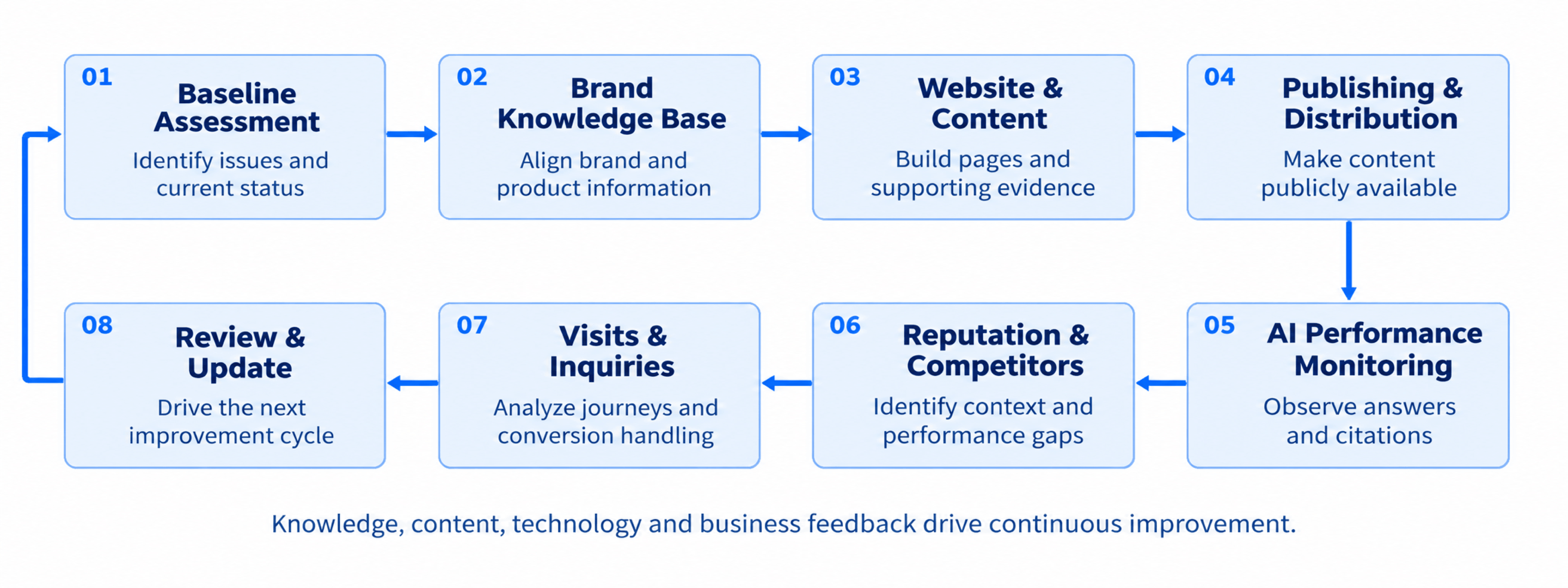
Note: arrows represent business relationships; specific tasks, cadence, and staffing are configured by project.
5.5 Access Control: Data Security and Stable Operations
The knowledge foundation stores public materials, internal operating information, and client project records. It must control both who can access information and what may be used externally. Classify materials as public, internal, or restricted, retain authorization scope for each fact, and apply least-necessary access to contracts, costs, personal contact details, and unpublished parameters.
| Control Stage | Implementation | Verification Evidence |
|---|---|---|
| Accounts and roles | Assign view, edit, approve, and export permissions by project | Permission list and live account tests |
| Materials and publication | Use materials by classification and authorization; redact screenshots first | Authorization records and approved versions |
| Tasks and recovery | Audit trails, backups, fault suspension, and recovery checks | Logs, incident tickets, and recovery records |
| Closure and handoff | Agree on asset export, account revocation, and cleanup confirmation | Handoff checklist, permissions, and cleanup records |
5.6 Project Acceptance: Delivery and Closed-Loop Management
Project acceptance should separate controllable delivery responsibilities from observed performance on third-party platforms. At kickoff, confirm target markets, question sets, baselines, content quantities, quality rules, cadence, and mutual responsibilities. Define completion separately for launch, acceptance, and ongoing operation.
| Deliverable | Pass Condition | Sample Evidence |
|---|---|---|
| Diagnosis and questions | Scope, question version, conditions, and baseline jointly confirmed | Question-level baseline and list |
| Knowledge and graph | Facts have sources, conditions are complete, and conflicts are resolved | Source files, fact details, and relationship records |
| Content and publishing | Copy approved; pages accessible and version-consistent | Approvals, URLs, and post-launch checks |
| Monitoring and reports | Denominators and decisions clear; conclusions trace to raw records | Test details, anomalies, and stage reports |
| Technical work and handoff | Technical tasks have status; training and handoff confirmed | Checklists, remediation, and handoff confirmation |
Set Checkpoints by Stage
Freeze scope, test conditions, and responsibilities at kickoff; sample facts, evidence, drafts, and access during development; verify URLs and approved versions after publication; and trace randomly selected report questions back to raw answers and sources during evaluation.
Estimate Capacity by Observation Unit
Planned observations = questions × entry points × repetitions per round × rounds. Example: 30 × 4 × 2 × 4 = 960 planned observations; retries and failures are recorded separately.
Items That Cannot Be Guaranteed
| No. | Cannot Be Guaranteed | Reason | Alternative Commitment |
|---|---|---|---|
| 1 | Control or intervention in any model's output or ranking | Models decide outputs based on version, prompt, and context | Execute agreed methods and report change through L1 retesting |
| 2 | Dominating an entry point, holding a fixed position, or excluding competitors | Output cannot be locked | Report visibility trends from baseline to retest |
| 3 | Permanent optimization effects | Model, corpus, and competitor changes can reverse results | Retest and maintain at the agreed cadence during service |
| 4 | Eliminating or suppressing negative information | Remediation is constrained by facts and law | Increase the share of correct information through compliant evidence |
| 5 | Winning citations with unsupported content | This conflicts with accuracy and creates compliance risk | Publish only after fact-level verification |
| 6 | Fixed article counts, content ratios, or industry rankings | Retrievable corpora and competition vary by industry | Provide project-specific ranges and calibrate through retesting |
This list defines service boundaries and is not a promise of any specific result. Actual scope follows the parties' project agreement.
06 Brand Reputation Monitoring and Competitive Insights
Brand Reputation Monitoring and Competitive Insights
6.1 Reputation Analysis: Brand-Risk Alerts in the AI Search Era
First confirm which brand, product, or service an evaluation concerns, then distinguish factual error, subjective opinion, and genuine business feedback. Negation, paraphrase, and comparison may alter meaning; automated classification supports screening only, and high-impact claims about credentials, product safety, or service commitments require human review. AI-answer samples and external media sentiment are recorded separately. NIST identifies confidently stated false information as a generative-AI risk and recommends verifying sources and citations in continuous monitoring [NIST Generative AI Risk Management Profile].
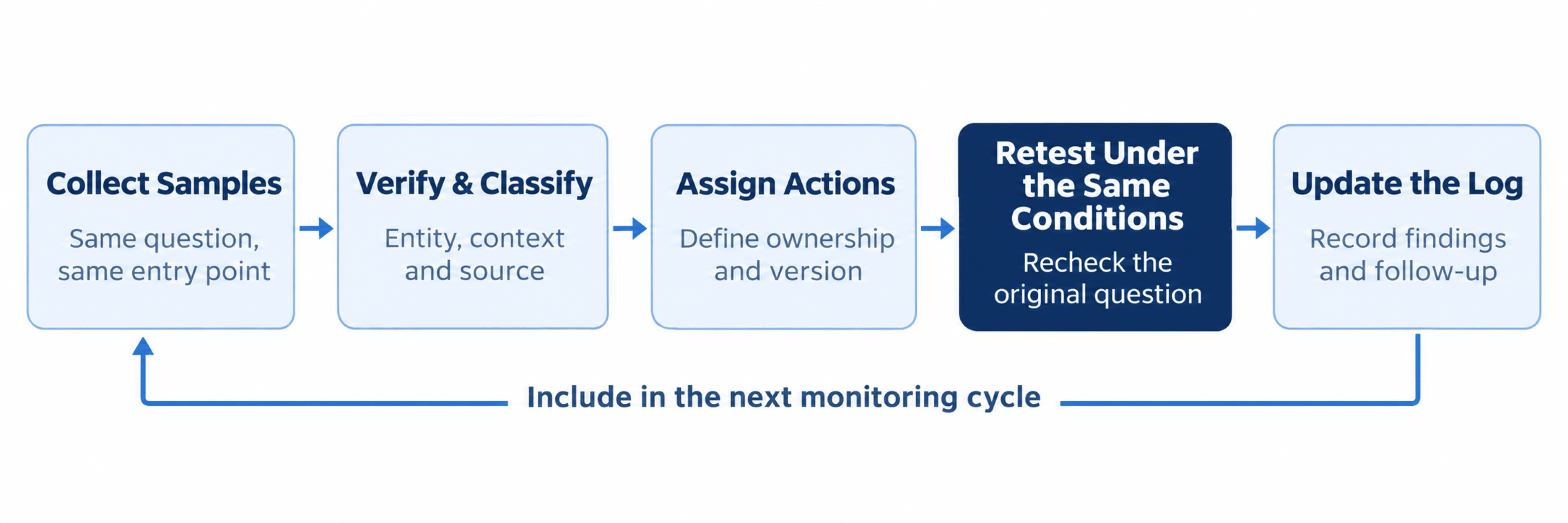
Retain the original question, entry point, time, complete answer, and visible sources. Open cited pages to inspect entity, version, and context, and cross-check against approved enterprise materials. Verify a one-off anomaly first; investigate a shared obsolete source if comparable errors recur. High-impact errors may be escalated immediately.
| Observed Situation | Priority Verification | Response |
|---|---|---|
| Factual error or entity confusion | Entity, model, credentials, and source version | Add official evidence, correct controlled pages, and retest |
| Genuine negative feedback | Whether the issue is valid and which product or service it concerns | Business team handles it and communicates progress within authorization |
| Unknown source or insufficient evidence | Original wording, context, and independent support | Mark pending verification, retain the record, and monitor change |
6.2 Competitive Insight: Benchmarking and Differentiation
Build the competitor set from purchasing scenarios. Select comparable companies by target market, product use, customer type, and delivery scope, then ask the same unbranded questions to observe which brands are mentioned, shortlisted, or explicitly recommended. Trace recommendation reasons to evidence—performance, applicable scenarios, delivery service, and cases—without inferring a competitor's internal strategy from answers alone.
6.3 Data-Driven Dynamic Strategy Optimization
Each optimization task should state the problem, evidence, target, owner, and retest conditions. Correct facts that could mislead buyers or create reputational risk first, then address recurring gaps affecting priority product lines. Preserve before-and-after samples and versions under Chapter 5's rules.
Website analytics can reveal identifiable sources, page flows, and key actions. Button clicks show that an action occurred; qualified inquiries still require business confirmation. Unknown sources remain unknown and must not be reverse-attributed to one AI entry point or article.
07 Long-Term Value, Brand Development, and Risk Mitigation
Long-Term Value, Brand Development and Risk Mitigation
7.1 The Content Moat and Irreplaceable Assets in the AI Era
Large models can generate generic copy instantly, but cannot replace a sourced test report or verifiable project case. Unique content assets come from a company's processes, product validation, delivery experience, and service records. A content moat is the continuing ability to organize, verify, and update those materials—not an expectation that content or recommendation positions remain permanent.
Operationalize this through a coordinated structure of one knowledge base, one official website, and multiple channels: the knowledge base unifies facts, the website provides authoritative and traceable structured pages, and channel publications extend the same evidence into relevant distribution environments.
7.2 Growth Transformation: From Traffic Chasing to Asset Accumulation
Moving from short-term traffic to asset accumulation means every investment leaves reusable output. Prioritize recurring purchase questions and decisive evidence. Store verified sales answers, selection guidance, delivery conditions, and case materials, then adapt them into website pages, industry articles, or sales materials. Update an adequate existing page before creating a duplicate.
7.3 Brand Development: Using Content Assets to Build Trust and Authority
Brand trust grows when customers can verify the same facts at different touchpoints. Product pages, cases, and sales conversations should use consistent parameters, credentials, and service boundaries. Industry authority comes from explaining professional questions with verifiable materials, stated evidence, and update dates—not from one citation or publication volume.
7.4 Risk Mitigation: Platform and Media Change
As entry points, indexing mechanisms, and user habits change, identical content may perform differently across channels. Keep the official website and maintainable enterprise knowledge as the long-term foundation, preserve stable URLs and update records, and avoid leaving essential evidence only on one uncontrollable channel.
| Risk | Signal | Response |
|---|---|---|
| Platform or entry-point rules change | Testing becomes unavailable or crawling, citation, or presentation changes | Record the change, inspect access policy, and create a new baseline if needed |
| Source or version expires | Broken links, old parameters, or inconsistent language versions | Revise the website and publications; verify redirects and source versions |
| Channel concentration | Core materials exist only on one external channel | Strengthen original evidence on the website and add audience-appropriate channels |
7.5 Content Compliance Boundaries and Long-Term Principles
Before publication, confirm disclosure rights. Brand identity, parameters, credentials, cases, and outcome data require evidence. Check permissions and redact customer names, screenshots, and third-party materials when necessary. Responsible owners must still confirm critical facts and professional conclusions after automated generation. Long-term operations should remain accurate, traceable, and maintainable.
7.6 Frequently Asked Questions
What is GEO?
Generative Engine Optimization is content and brand optimization for AI search and generated answers. It organizes brand and product information, develops public sources, and produces professional content so relevant facts can be understood and presented accurately.
How does GEO differ from “geo” in geographic information systems?
Here, GEO concerns brand and content presentation in AI search. Geographic information systems are normally abbreviated GIS and process, analyze, and visualize geospatial data.
How does GEO differ from traditional SEO?
SEO emphasizes discoverability, crawlability, and search performance. GEO additionally asks whether brand information is accurately described, mentioned, or cited in generated answers.
What is GEO's core objective?
Improve brand and product visibility and factual accuracy in relevant answers, then observe changes through sampled mention, citation, and recommendation-context metrics.
Which AI platforms does GEO address?
Typical contexts include conversational or search products such as Doubao, Kimi, and DeepSeek, plus Google AI Overviews, Microsoft Copilot, and ChatGPT search. Actual scope follows target markets, languages, user entry points, and the project agreement.
What is GEO's underlying principle?
Search-enabled generative systems retrieve public materials and combine them with the question and context. GEO unifies brand entities, explains applicable conditions, and supplies verifiable materials so those sources can be understood and used more reliably.
What methods does GEO use?
Common methods include unifying brand and product facts, organizing content around authentic questions, adding verifiable tests, credentials, and cases, checking consistency across the website and external channels, and retesting with the same questions.
What does GEO require from content?
Content should answer the user directly and state the entity, applicable conditions, evidence, and update time. Important conclusions should be supported by verifiable data, cases, or sources.
Why does GEO emphasize E-E-A-T?
Experience, expertise, authoritativeness, and trustworthiness are useful dimensions for content quality. First-hand validation, named authors and reviewers, public evidence, and stated scope help readers judge reliability.
How is a semantic network optimized for GEO?
Unify company, brand, and product-line names, aliases, and official pages; then connect scenarios, parameters, cases, and credentials. Use consistent terminology, relevant internal links, and structured data that matches visible content.
08 Case Studies and Service Solutions
Case Studies and Service Solutions
Buyers begin with a problem: which equipment fits an added production step, how two solutions differ under continuous operation, or which packaging prevents moisture and powder leakage in long-distance transport. Families ask where to stay with children; event planners ask which venue can provide meetings, lodging, and meals. GEO must first help a company's products and services appear in answers to these questions, then provide enough information for users to judge fit.
Bincial begins with the decision scenarios clients want to enter, examines which companies and sources AI already presents, and maps the company's public evidence to the same questions. The following anonymized cases show how different business needs became publishable, reviewable content.
8.1 Case One: Industrial Equipment and Components
This company serves engineers and procurement teams. Buyers usually begin with a process requirement, ask whether equipment can fit an existing production line, and then ask how to verify it. Bincial created separate records for each product line, linked applications, cases, and credentials, and configured monitored questions around operating conditions, solution selection, and sample validation.
From October 15 to November 15, 2026, the project monitored 23 scenarios, published multiple new pieces, and recorded 1,431 citations of published articles within the monitored sample. The value was turning existing technical material into evidence prospects could discover and verify during purchasing research.
8.2 Case Two: Hotel and Conference Services
The hotel provides accommodation, dining, meetings, and banquets. A single overview cannot answer every question about family travel, room type, transport, venue use, supporting facilities, and quotations. Bincial organized service materials by decision scenario and maintained rooms, dining, conferences, and facilities in the knowledge base.
The first period ran from September 13 to October 14, 2026, and the second from October 15 to November 15, 32 days each. Citations of published articles rose from 136 to 858, an increase of 722. Monitored scenarios also expanded from 53 to 106, so these figures represent total citations within the changing project scope. Improvement on identical questions still requires fixed-question, fixed-platform retesting.
8.3 Case Three: Packaging Manufacturing
Packaging buyers often know what must be packed and how it will be stored and transported, but not which material or structure to search for. Bincial maintained product-line descriptions and cases, configured purchasing-scenario questions, and organized content around use, logistics conditions, and fit requirements.
From October 15 to November 15, 2026, the project monitored 30 scenarios, published 25 new pieces, and recorded 572 citations of published articles. Companies with similar technical-sales processes can first verify whether content enters AI answers, then use answer snapshots and business records to determine whether buyers found the right product.
Case data comes from the Bincial client workspace. Project materials can be reviewed in Brand Knowledge Base and AI Publication Records; stage data appears under GEO Performance Monitoring, and raw answers under AI Q&A Snapshots.
8.4 Company Capabilities and Service Solutions

Bincial GEO is a brand of Shanghai Bozhi Technology Co., Ltd. Its team spans AI products and algorithms, search marketing, and enterprise services. Bincial brings brand diagnosis, enterprise knowledge bases, content engineering, channel distribution, intelligent website development, and performance monitoring into one delivery system for domestic operations, international expansion, and multi-brand group projects.
Company and service information: [Bincial official website: company and team] [Bincial official website: services and platform coverage]
Client Coverage and Delivery Priorities
Industrial manufacturing: equipment, automation components, HVAC, new materials, and packaging, with emphasis on parameters, operating conditions, credentials, and application evidence.
Cross-border and technology: localized content by market language and selection habits, with evidence placed on pages that lead to inquiries.
Hotels and local services: facilities, service conditions, booking methods, and query or quotation paths for lodging, dining, conferences, and events.
Institutions and associations: public content organized around services, eligible audiences, and application processes.
Core Capabilities and Deliverables
Bincial defines scope through a diagnostic report. After contract signing, a customer-success manager coordinates implementation. The platform organizes questions, content tasks, publishing, and monitoring; the project team and client verify product facts, disclosure rights, and business objectives.
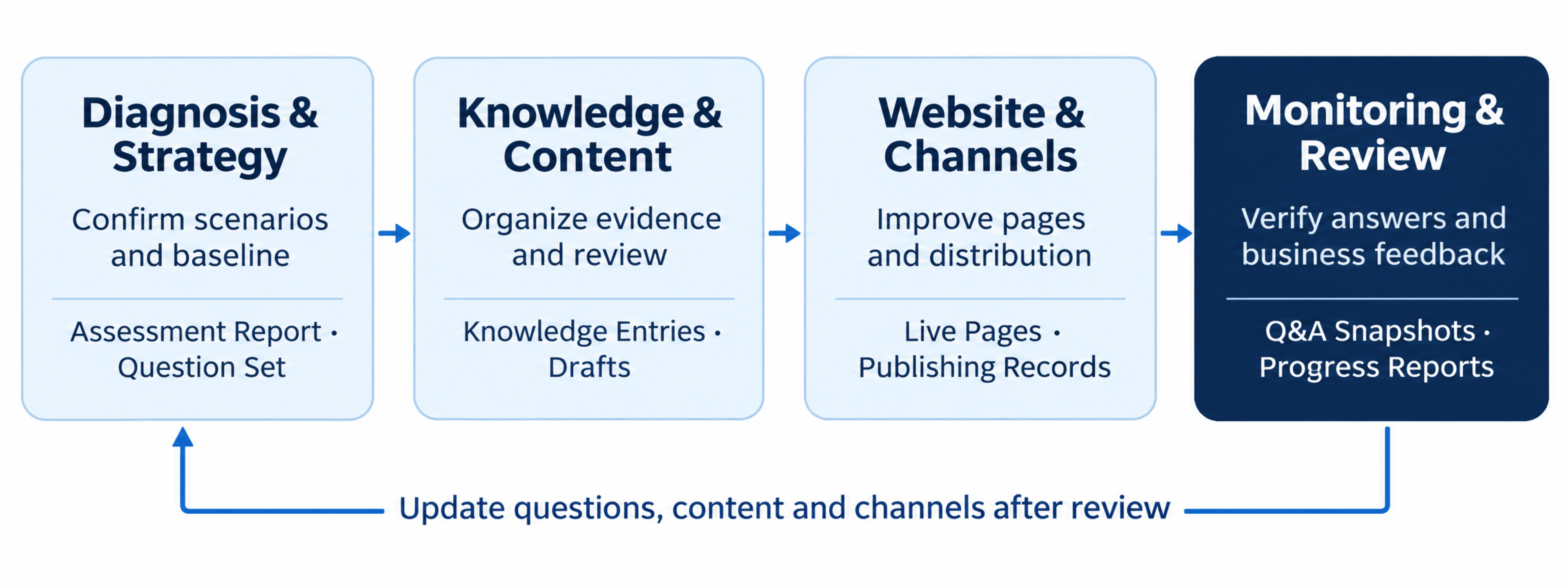
Engagement Models
| Configuration | Suitable Need | Primary Services |
|---|---|---|
| Domestic foundational operations | Existing website and public materials; priority domestic brand or product line | Multi-platform diagnosis, scenario content, publication, and stage monitoring |
| Website and content development | Insufficient public information or hard-to-find product and inquiry details | Knowledge base, website build or redesign, content sections, and inquiry paths |
| International expansion | Buyers across markets and languages | Localized selection content, international website and channels, market-level monitoring |
| Enterprise custom delivery | Multiple brands, product lines, or domestic and international teams | Market-specific knowledge, websites, and distribution with unified review and acceptance |
Contact Bincial · www.bincial.com · support@bincial.com
Appendix A Glossary
Appendix A: Glossary
Abbreviations, engineering concepts, metrics, and delivery terms used in this white paper. Denominators, scope, and sample rules appear in Chapter 5 and Appendix B.
Generative Search and Purchasing Scenarios
| Term | Definition |
|---|---|
| AI / Generative AI | Systems that recognize, infer, or generate content; here, primarily systems producing natural-language answers. |
| GEO | Generative Engine Optimization: improving visibility, accuracy, and verifiability in generated answers through enterprise knowledge, content, websites, and sources. |
| SEO | Search Engine Optimization: improving webpage discoverability, crawlability, and search performance. |
| AEO | Answer Engine Optimization: optimizing direct answers for answer-oriented surfaces such as featured snippets and voice assistants. |
| LLM | Large Language Model; a model trained on language patterns to generate text. |
| AI search | A search experience that organizes queries and retrieved materials into a generated answer. |
| Brand visibility | Whether and where a brand is recognized, mentioned, or shortlisted within a defined sample and observation window. |
| Search intent | The task a user seeks to complete; long-tail questions add specific objects, scenarios, or conditions. |
| B2B | Transactions or services between businesses. |
| MOQ | Minimum Order Quantity. |
| UGC | User-Generated Content, such as reviews, experience reports, and community answers. |
| GIS | Geographic Information System, used to manage and analyze geospatial data. |
Question Design, Knowledge Engineering, and Quality
| Term | Definition |
|---|---|
| Question set / scenario question | Authentic questions organized by market, audience, product, and decision intent. |
| Core set / exploration set | The core set preserves baseline comparability; the exploration set captures new products, long-tail scenarios, and markets. |
| Baseline diagnosis | Initial samples collected under agreed questions, entry points, and conditions before development. |
| Knowledge foundation | Assets and systems managing shared brand facts, product-line materials, originals, versions, and permissions. |
| Knowledge graph | Nodes and relationships connecting brands, products, applications, credentials, and evidence. |
| Chunk / token | A chunk is a retrievable document fragment; a token is a basic text unit used by a model. |
| Embedding / vector index | Numerical representations and indexes used for semantic similarity and retrieval. |
| RAG | Retrieval-Augmented Generation: retrieving external material before generating an answer from it. |
| Hallucination | Unsupported content or fabricated, misattributed, or unverifiable citations stated with confidence. |
| E-E-A-T | Experience, expertise, authoritativeness, and trustworthiness. |
Website Technology and Content Operations
Key terms include crawling, indexing, robots.txt, server-side rendering, Sitemap, canonical and hreflang, structured data, Schema.org, JSON-LD, Organization, Product, Service, Article, Breadcrumb, FAQPage, sameAs, Core Web Vitals, CTA, conversion paths, L1–L3 metrics, attribution, controls, SOPs, least-necessary access, redaction, and asset handoff.
Monitoring, Attribution, and Operations Management
Key terms include planned observations, valid answers, mention rate, recommendation rate, first-position recommendation rate, factual accuracy, required-fact coverage, specified-source citation rate, retesting, sentiment analysis, competitive benchmarking, qualified inquiries, acquisition cost, ROI, audit trails, and asset handoff.
Appendix B References and Methodology
Appendix B: References and Methodology
Research and Risk Assessment
Primary research referenced in this white paper includes CNNIC's 2026 generative-AI adoption report; Aggarwal et al., GEO: Generative Engine Optimization; Webster and Wind's organizational buying model; Yuvzhenko and Stirenko's 2026 chunking study; Bennani and Moslonka's systematic chunking analysis; the EBU and BBC study of news integrity in AI assistants; repeated visibility measurement research; and the NIST Generative AI Risk Management Profile.
Bincial Public Materials and Disclosures
Company, service, FAQ, and case information is verified against the Bincial company profile, service overview, and customer cases. Anonymized Chapter 8 data is verified through the project workspace as described below.
Engineering and Platform Documentation
Implementation references include RAG update engineering practices, AI-oriented website architecture, structured-data guidelines, Core Web Vitals, OpenAI crawler documentation, Bing AI visibility and citation-share documentation, Google Analytics source dimensions, helpful-content guidance, site-migration guidance, and guidance for generative-AI content.
Methodology and Case Evidence
Question and Sample Design
Build sets by market, language, product line, and decision intent. Freeze question versions, platform entry points, test windows, repetition counts, and judgment rules at project start. Record every planned observation with its conditions, complete answer, and citation links.
Validity and Assessment
Complete answers remain in the denominator even without a target-brand mention. No explicit citation is recorded as no citation. Timeouts, refusals, restrictions, and incomplete collection are reported separately.
Metrics, Retesting, and Causal Limits
Use the definitions in Section 5.2 and disclose numerator, denominator, date, and platform. Baseline and retest should retain the same questions, entry points, and conditions. L1 model answers, L2 website visits, and L3 qualified inquiries remain separate evidence layers.
Case Verification
Chapter 8 uses anonymized Bincial service records. Facts and actions can be reviewed in the client workspace; answer and citation data can be verified through GEO Performance Monitoring and AI Q&A Snapshots.
Authorization and Use
This white paper is published by Shanghai Bozhi Technology Co., Ltd. Citations, figures, screenshots, and client materials are used within their respective permissions. Client authorization, data windows, and identifying information are checked before external display.
Appendix C Supporting Materials Checklist
Appendix C: Supporting Materials Checklist
Use this checklist for prepublication review and future version updates. P1 items require priority evidence or confirmation; P2 items require organization and archiving.
Evidence and Citations
| Priority | Material | Acceptance Condition | Suggested Owner |
|---|---|---|---|
| P1 | External research and technical evidence | Verify publisher, author, version, figures, conditions, and primary sources | Editorial / Technical |
| P1 | Evaluation consistency | Verify comparable samples, denominators, failures, baselines, retests, and causal wording | Data / Editorial |
| P1 | Case data and dashboard evidence | Export counts for the stated windows and verify metric definitions and sample changes | Customer Success / Data |
| P1 | Client authorization | Archive disclosure scope and review screenshots, metadata, and identifying details | Customer Success / Review |
Publication Materials and Archiving
| Priority | Material | Acceptance Condition | Suggested Owner |
|---|---|---|---|
| P2 | Website technical verification | Retain representative URLs, crawl status, visible content, markup validation, events, tools, and dates | Web / Technical |
| P2 | Knowledge, publication, and monitoring visuals | Archive source files, field notes, versions, permissions, redacted visuals, and alt text | Product / Design |
| P2 | Project acceptance and handoff | Archive questions, checklists, revisions, reports, assets, revoked access, and unresolved items | Delivery / Customer Success |
| P2 | Publication review | Check navigation, links, source access, terminology, and image quality; retain reviewed and final versions | Editorial / Publishing |
Archive records should include material name, source or location, version, statistical window, owner, authorization scope, and review date. Unverified figures and conclusions remain in the review log until confirmed.